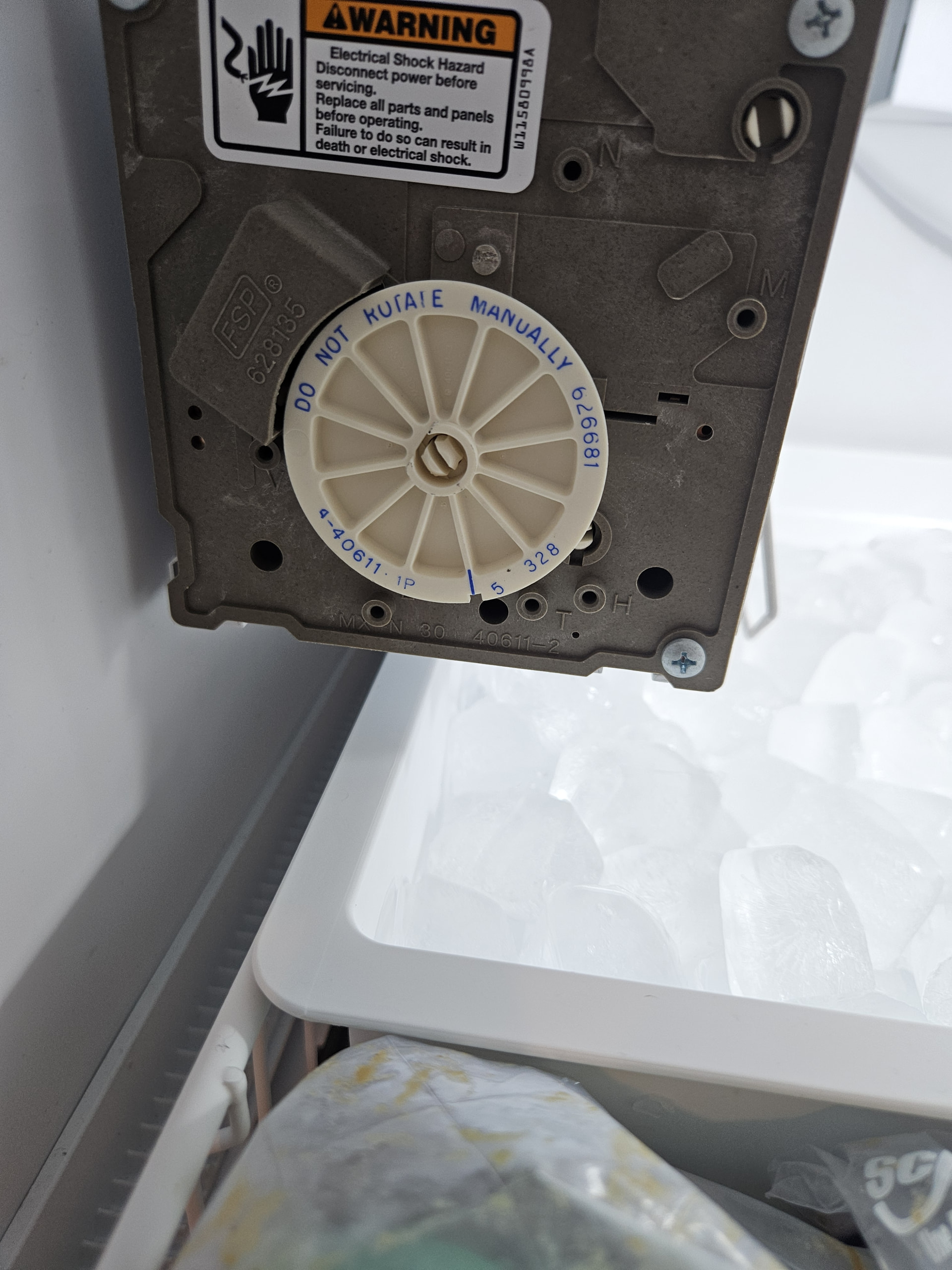
Good morning. One evening I noticed that I had ice stuck in my ice maker so I took it out. After about 24 hours I realized that it was not making ice. While using a wire to troubleshoot i deemed that the gears were stripped in the current ice maker, while slowly turning water did come out.
I ordered and replaced the whole ice maker and its still not making ice. It seems to turn to where the picture is then stop. If I pull up the wire and bring it back down it will rotate back to that spot. The temp in freezer is about -4 degrees.
I assume it is the water valve, but not sure because it was working fine till it jammed up
Thanks for the model number! Your Whirlpool WRB329DMBB00 uses a modular-style ice maker, which helps narrow down the problem.
Based on what you’ve described, I would hold off on replacing the water inlet valve until we verify whether the new ice maker is actually calling for water.
The fact that the gear rotates and returns to the same position suggests the motor is operating. That position may simply be the normal resting position, rather than a sign that something is binding.
Since your freezer is at -4°F, temperature shouldn’t be preventing the ice maker from operating.
Here’s the test I’d recommend
For this style of ice maker, the test holes are behind the white front cover shown in your picture.
Check the fill tube first. Make sure the tube entering the ice maker isn’t blocked with ice.
Check ice maker power. With a multimeter set to AC volts, test between terminals L and N. You should read approximately 120 VAC.
Run a harvest test. If you’re comfortable performing a live electrical test, use a properly insulated jumper between T and H to initiate a harvest. Remove the jumper after approximately 3 seconds. The ice maker should continue rotating and eventually call for water. Do not leave the jumper installed or manually turn the gear.
Watch for water filling. If the ice maker completes its cycle but doesn’t fill, the next step is checking for approximately 120 VAC between V and N during the brief fill period.
Manuals+
+1
If voltage reaches the valve but no water enters the mold, suspect the inlet valve, frozen fill tube, or restricted water supply. If no voltage is sent during the fill portion, investigate the ice maker module and wiring instead.
One question before you start: When you lower the shutoff arm and the gear rotates back to the position in your picture, does any water enter the new ice maker, or does it remain completely dry?
That answer will help determine which test to concentrate on next.
Good evening. Thank you for the guidance. I just did the test.
I checked the fill tube and it is not blocked.
I have 124 volts between terminals L and N.
When I do the test between T and H to Initiate harvest it states to turn, but as soon as I take out the wire it stops.
I did, bring the wire down and held my finger on the door switch, I watched it turn all the way around, only took about a minute or so, it did make a few clicking sounds and just when it stopped their was a green flash behind the dial.
When i do flip up the shut off arm, I need to keep it up for some time, but when I do flip it down, it rotates but no water comes out.
I guess thats what confuses me the most, water did come out of the old one.
Good evening! Thanks for running those tests and providing such detailed results. You’ve actually narrowed this down quite a bit.
The 124 volts between L and N is good, so we know the ice maker is receiving power. The fact that the motor rotates when you lower the shutoff arm also tells us the motor is capable of running.
What concerns me is that the ice maker completes a rotation but never fills with water.
Here’s what I’d check next.
1. Check the T-to-H harvest test. Normally, you only need to hold the jumper in place until the motor starts moving, then remove it. The motor should continue through the harvest cycle on its own. If it stops immediately when you remove the jumper, that could indicate a problem with the new ice maker’s internal contacts or module.
2. Check for voltage at the water inlet valve. This is the most important next test. Disconnect power, locate the ice maker’s water inlet valve at the back of the refrigerator, and connect your meter leads across the valve’s two electrical terminals. Secure the leads before restoring power. During the fill portion of a harvest cycle, you should briefly see approximately 120 VAC, usually for several seconds. Be careful because this is a live-voltage test.
3. Interpret the results.
If you get approximately 120 VAC but no water enters the ice maker, suspect the water inlet valve or a restriction in the water supply.
If you never get 120 VAC, the problem may be in the ice maker’s internal fill contacts, wiring, or control circuit.
If the motor stops as soon as you remove the T-to-H jumper, that makes me more suspicious of the replacement ice maker itself.
The green flash you noticed behind the dial isn’t enough by itself to identify a failure.
One other thing: The fact that the old ice maker dispensed water suggests the water valve was working at that time. That makes me hesitant to recommend replacing the valve without testing it first.
I have two questions:
When you say the ice maker rotated all the way around in about a minute, did it complete that rotation entirely on its own, without the T-to-H jumper installed?
Also, when it reached the end of that rotation, did you hear a humming or buzzing sound from the back of the refrigerator, even briefly?
Those two answers will help us determine whether the new ice maker is failing to send power to the water valve or whether the valve is receiving power but not opening. I wouldn’t order another part just yet.
Ok, when I stopped testing the other night I flipped up the on off wife. When I started testing tonight, I flipped the switch to on, put in the wire between T and H and pushed the door switch. Once it started to turn i took out the wire and it made a full cycle.
I then did it again, but this time I tested the voltage at the water inlet valve, I had 124 volts for about 5 seconds or so. But I did not hear it do anything. (Probably unrelated but when I took off the back cover I had a small amount of water in the pan under the fan).
Yes it rotated all the way around with the wire out as long as you held the door switch closed. It did not do that last time, maybe I took the wire put to soon?
I don’t recall hearing a buzzing sound in the back of the refrigerator
The water fill tube does not seem frozen, but to make sure we are going to move all the items from to freezer to another one, then turn it up to like 1 for 24 hours to make sure its not frozen.
@Jeffrey_S_APP_Team I tried to turn my freezer down, but it didn’t get as warm as I thought it would. Do you have any other things that i can try to get this figured out.
Thanks for the detailed update! You’ve made some really good progress, and your latest voltage test gives us an important clue.
On your Whirlpool WRB329DMBB00, the ice maker completed a full harvest cycle after you jumped terminals T and H, removed the jumper, and held the freezer door switch closed. That tells us the ice maker motor and harvest mechanism are working.
The biggest clue is that you measured approximately 124 volts at the water inlet valve for about five seconds, but didn’t hear the valve operate or see water enter the ice maker. That points us toward the water inlet valve, its electrical connections, or a restriction in the water supply rather than the ice maker itself.
Here’s what I’d check next.
1. Check the water inlet valve connections. Unplug the refrigerator and inspect the wiring connections at the valve. Make sure they’re secure and that no terminals are loose, damaged, or corroded. If your refrigerator has separate valve connections for the dispenser and ice maker, make sure you’re testing the ice maker circuit.
2. Confirm the voltage directly across the valve terminals. Since you already measured 124 volts, I’d like to confirm that reading was taken across the two electrical terminals supplying the ice maker valve, with the connector attached, during the fill portion of the harvest cycle. If you’re comfortable performing another live-voltage test, use insulated probes and keep your hands clear of exposed connections. If you get approximately 120 volts across the connected valve but no water enters, that makes the valve or water supply a strong suspect.
3. Check the water supply. With the refrigerator unplugged and the water supply turned off, inspect the supply line for kinks. If you’re comfortable disconnecting the line at the refrigerator, you can direct it into a bucket and briefly open the shutoff valve to confirm you have good water flow. A restricted supply could prevent filling even when the electrical circuit is working.
4. Check the ice maker fill tube. It’s worth checking for ice, but I wouldn’t empty the freezer and leave it on a warmer setting for 24 hours just yet. A simpler approach is to inspect the tube where water enters the ice maker. If you find ice, thaw it gently with warm water or a warm cloth. Avoid excessive heat that could damage the plastic tubing.
The small amount of water you noticed in the drain pan underneath the refrigerator is usually normal. That’s where water from the automatic defrost cycle collects and eventually evaporates. Unless the pan is overflowing or you notice an active leak, I wouldn’t consider that related to the ice maker problem.
Also, the fact that the freezer didn’t warm up as much as expected when you changed the setting isn’t necessarily a problem. Refrigerator temperature adjustments can take quite a while to stabilize.
At this point, I would not replace the ice maker. Since it completes a harvest cycle and you’ve measured voltage at the water valve, I’d concentrate on confirming that the valve is receiving power under load and that water can reach it.
I have two questions that will help us narrow this down:
When you measured the 124 volts at the water inlet valve, did you have your meter probes across the two wires connected to the valve, or did you disconnect the connector first?
Does your refrigerator have a working water dispenser, or is the ice maker the only feature using the water supply?
Those answers will help us determine whether the water inlet valve itself is the most likely problem or whether we need to check the supply and fill tubing first.
@Jeffrey_S_APP_Team thank you, when I tested the water inlet valve, I tested it with the harness plugged into it. And 1 lead of my volt meter on each side.
If the water inlet valve is not supplying the water, would that cause the ice maker to stop and not complete another cycle?
First, you tested the water inlet valve correctly. With the wiring harness connected and one meter probe on each of the valve’s two electrical terminals, your reading of approximately 124 VAC for about 5 seconds tells us the ice maker is sending power to the valve during the fill portion of its cycle.
Now, to answer your question: Yes, a faulty water inlet valve can prevent the ice maker from producing more ice, but it normally won’t prevent the ice maker from completing another harvest cycle.
Here’s how that works.
The ice maker goes through a harvest cycle, ejects the ice cubes, and then sends power to the water inlet valve to refill the mold. If the valve receives 124 VAC but doesn’t open, the mold stays empty.
However, the ice maker doesn’t directly monitor whether water actually entered the mold. It relies on temperature to determine when to initiate another harvest.
Without water in the mold, the ice maker may still cycle, but you won’t get any ice. Depending on the ice maker’s design and temperature conditions, it may also take some time before another cycle occurs.
Here’s what I’d recommend next.
Since you’ve already confirmed that the ice maker completes a harvest cycle and sends 124 VAC to the water valve, I would concentrate on the water supply before replacing anything else.
Check the fill tube. Make sure it is completely clear of ice.
Check the water supply. Verify that the refrigerator’s water supply valve is fully open and that water is reaching the inlet valve.
Check the inlet valve. If water is reaching the valve and it receives 124 VAC during the fill cycle, but no water comes out, the inlet valve is very likely defective.
Manuals++1
Remember, you’re working around live 120-volt connections during the voltage test, so use insulated probes and disconnect power before removing any tubing.
One question that will help narrow this down:
When you measured 124 VAC at the inlet valve for approximately 5 seconds, did you hear any humming or buzzing from the valve, or was it completely silent?
That will help us decide whether to focus on the valve itself or investigate the water supply further.