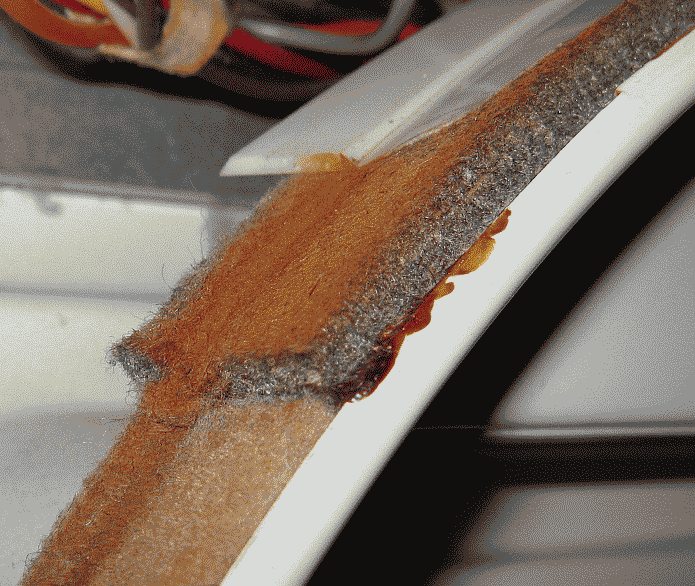
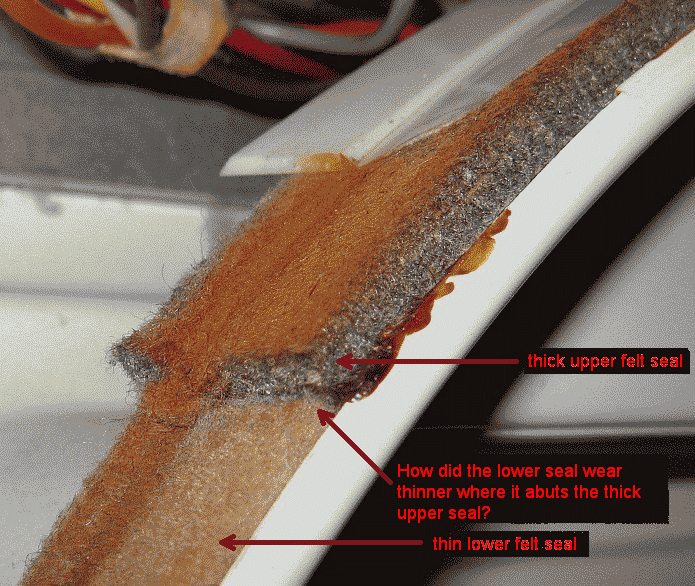
A few years ago I replaced the upper and lower front seals (and the rear bearing). The lower seal’s thickness is about a quarter inch where it’s not worn, which is about half the upper seal’s thickness. Before I installed them I wondered about the mismatch in thickness and whether it would make a proper seal, but I trusted it because the part numbers were right and the bag was marked “genuine Electrolux.”
I recently ordered a “preventative maintenance kit” that includes new seals. The new lower seal is as thick as the new upper seal (and the old upper seal) which intuitively seems right. They’re about half an inch thick. (The new lower seal is white and might be made of a synthetic material. I don’t think it’s felt, unlike the older seals and the new upper seal.)
How thick should the lower seal be? Should it be half as thick as the upper seal, or should the lower seal and upper seal be the same thickness? Should they both be about half an inch thick?
The dryer tends to overheat. Its top gets uncomfortably hot to the touch, and a temperature probe inside the back panel on the steel next to the fuse shows that the fuse will reach its blowing temperature if I don’t frequently switch the temperature dial to “no heat.” I suspect the cause is a leaky seal. I think I’ve ruled out air obstructions or a partially shorted heating coil, and I don’t think the thermostats are relevant to overheating of the dryer cabinet. (Here’s why I think the thermostats are irrelevant: The cycling thermostat, which senses the exhaust temperature, seems designed to stay closed due to evaporative cooling until the clothes are nearly dry. I can tell the cycling thermostat opens and closes late in the cycle when the clothes are dry or nearly dry, by observing when the temperature begins to fluctuate down and up; also the peak temperature during these fluctuations is much lower than the temperature during most of the cycle. This is a sensible design, because while the evaporative cooling is protecting the clothing there’s no need to run the heater at less than full heat, and it would waste time and cause unnecessary wear and tear on the clothes and the dryer to run longer at less than full heat. The high limit thermostat is designed to stay closed unless some other problem causes overheating. Also, by simultaneously observing the temperature at the fuse and the temperature at the high limit thermostat, I see that the fuse gets hot even while the temperature at the high limit thermostat is below 245F, where the 285F-40L high limit thermostat is spec’ed to be irrelevant.)
A leaky front seal would create an undesirable alternative path allowing a portion of the heated air to flow OUTSIDE the drum into the leak. The path is outside the drum but inside the dryer cabinet, so the cabinet will heat up. Does this make sense? Can it be significant enough to explain the overheating?
I haven’t yet tried to verify that’s what’s happening. One way I may try is to place a video camera and flashlight inside the cabinet pointed at the seal, and place a source of smoke (burning incense) near the heating coil, to check whether smoke flows into the seal. (I would set the dial to “no heat” to protect the camera, and take the belt off the motor pulleys to minimize turbulence.) Another test might be to place tiny bits of paper outside the seal to check whether they find their way into the lint trap.
Another concern is that the three nylon upper glides are worn thin even though they’re only a few years old. One of the three glides has even lost a corner; it broke off after the glide got thin. So I plan to replace the upper seal and glides too. I’m wondering whether the new thicker lower seal will increase or decrease the wear on the upper glides, compared to the wear on the upper glides with the current half-thick lower seal. On the one hand, the extra thickness might increase the pressure against the rotating drum all the way around, including on the glides, causing more wear on the glides. On the other hand, since the lower seal is much longer than the upper seal, part of the lower seal is on the upper half of the opening, so maybe the extra thickness on the upper half will help bear some of the weight of the drum, reducing the weight and wear on the upper glides. Does anyone have an opinion about whether the thicker lower seal will increase or decrease the wear on the upper glides? (This concern is why I haven’t yet installed the new seals.)
For awhile I thought the reversing motor feature might contribute to the overheating because the air flow pauses for a few seconds each time the motor changes direction. But observation of the temperature at the fuse has shown the effect of the pauses is tiny… a rise of only about one degree, after a pause.
Thanks in advance to anyone who tries to help!