Brand: GE Model Number: wkse5260e0ww (top loader, about 25 years old) Main Symptom: Coasting What happens & when: Drum continues spinning (coasting) after wash and rinse cycles.
Error Code (if any): Ran “Field Service Mode”, but unsure how to interpret results.
Parts or tests already tried: None yet.
Photos / video link:
I replaced the agitator coupler a week ago (plastic splines stripped) and a few days ago the machine began coasting after final spin. Now it’s coasting (brake not being applied…just keeps spinning until it runs out of momentum) after wash and rinse cycles and today there was a small water leak from the drum.
I’ve replaced the drum seal before (a year or so ago) and can do that again but don’t want to just throw parts at it.
I can’t figure out how to interpret the lights when running Field Service Mode. LOL, it doesn’t help that the original documentation with the machine is so fuzzy that some of it is unreadable.
From what I’ve seen the coasting may be a transmission problem (I replaced it a few years ago), but are there any other potential causes to check for coasting?
Thanks for the detailed information! The coasting does sound like a possible transmission or brake assembly issue, but there are a few things I would check before replacing the transmission again, especially since you’ve recently noticed a water leak.
The number WH38X10002 is actually a GE transmission and brake assembly part number rather than the washer’s model number.
On these older GE top-load washers, the mechanical brake should engage when the motor stops driving the basket during spin. If the basket continues spinning until it naturally loses momentum, the brake may not be engaging properly.
Here’s what I would check first:
Tub seal and water leakage: Unplug the washer, remove the front panel, and inspect underneath the outer tub. Look for water trails, rust, or oily residue running down the transmission toward the brake assembly. Water or oil contamination could interfere with the brake’s ability to grip.
Drive belt and transmission pulley: Check for a loose pulley nut, pulley damage, belt deterioration, or anything binding that could prevent the brake from reengaging.
Basket hub and mounting nut: Check that the inner basket is securely attached to the transmission. A loose hub nut or damaged hub could allow the basket to move independently of the transmission.
Brake assembly: With the washer unplugged and the drive belt removed, check whether the basket turns freely by hand in its normal spin direction. If there is very little resistance and the basket continues rotating freely, the brake may not be holding.
Transmission shaft: Check for excessive side-to-side movement, corrosion, or pitting where the tub seal rides. This could explain why the seal is leaking again after only a year.
The brake is part of the WH38X10002 transmission assembly and is not considered separately serviceable by the manufacturer. Unfortunately, the assembly has also been discontinued.
Appliance Parts Pros+2
Replacing the agitator coupler normally would not affect brake operation, so the timing may simply be a coincidence.
A few questions:
How long does the basket continue spinning after the motor shuts off?
Does the basket rotate continuously during agitation?
Is the leak coming directly from the center underneath the outer tub?
Could you provide the complete washer model number from underneath the lid, along with a picture of the lights during Field Service Mode?
I would be happy to help interpret the diagnostic results once we have the correct model number.
Right now, my biggest concern is the possibility of a leaking tub seal contaminating the brake assembly. I would avoid operating the washer until we determine why the brake isn’t engaging, since it is an important safety feature.
Hi Jeffrey and thank you for your post! My bad on putting in the transmission part number, but replaced it in original post with model (wkse5260e0ww).
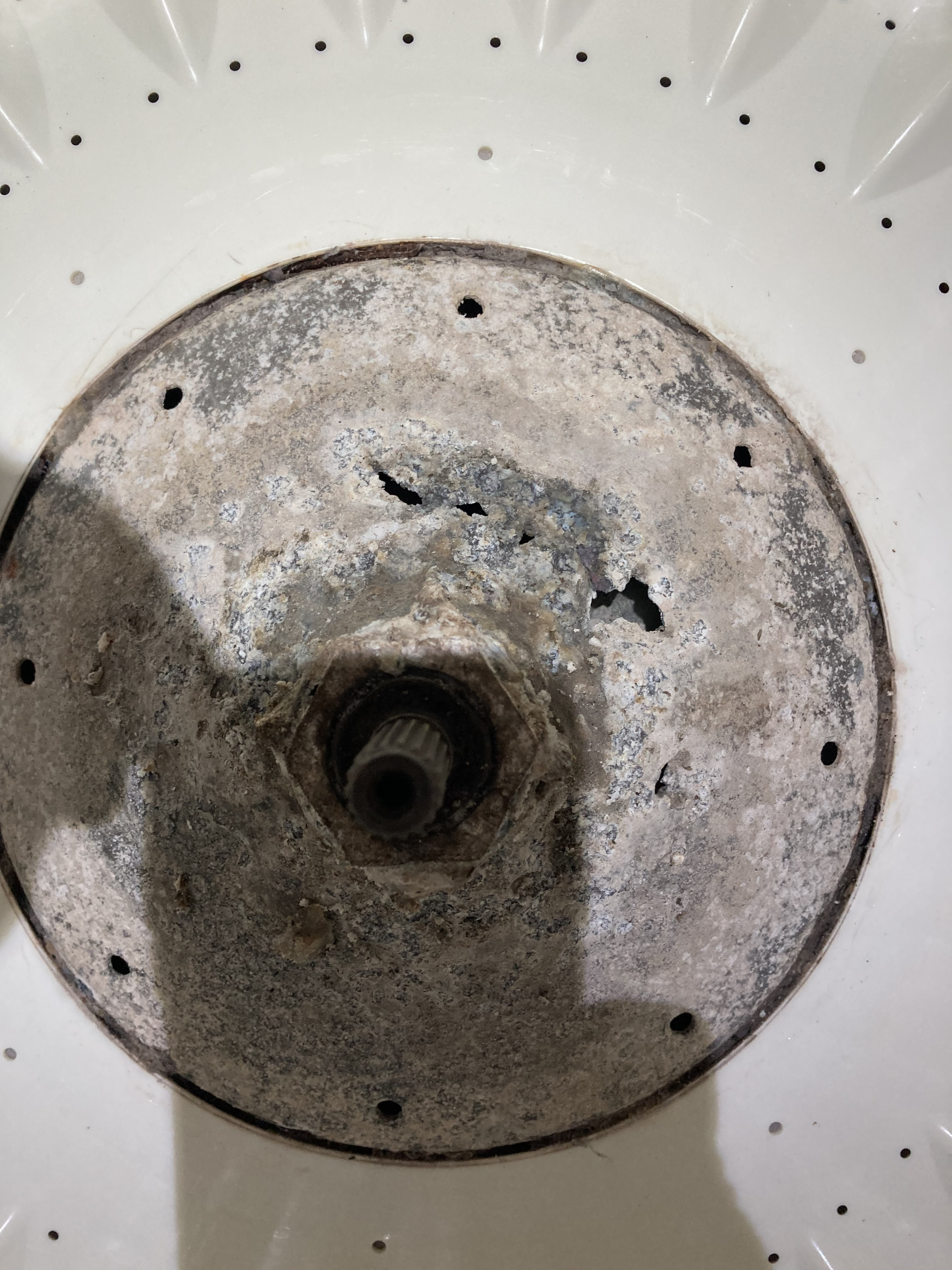
In “what to check”…in total, maybe a cup or so of water which looks to have come from the tub seal; no oily residue. Pully nut and belt tight, no damage to belt. When I had agitator off to replace coupler, there wasn’t any play in shaft that I could tell and the nut was corroded on. Our machine has severe aluminum corrosion; the nut is very corroded (the old one was a nightmare to get off) and the Washer Inner Tub Mounting Hub has a couple of small rot holes in it (pic attached).
To answer your questions…the basket spins for about a minute after the motor shuts off. I hadn’t noticed whether the basket rotates during agitation, but it’s been working and sounded normal for the past week since changing the coupler. I’m not 100% sure of where the leak was from, but there was water toward the top of the transmission, so I figured it was coming from the tub seal.
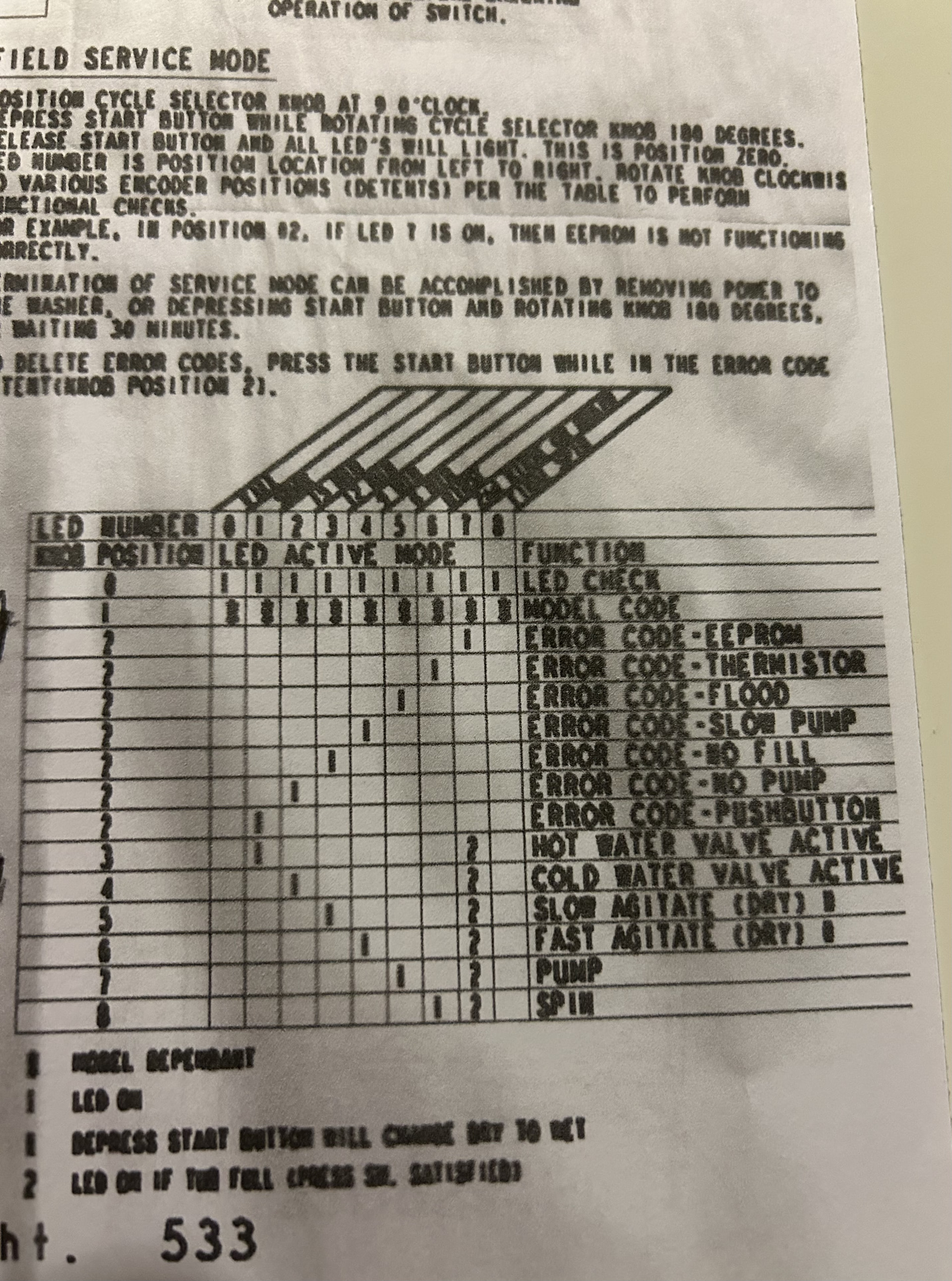
Attached are pics of the Field Service Mode diagram and the mounting hub. I’ll attach a short video of the diagnostic next.
Thanks for the update and the pictures! That mounting hub is in considerably worse condition than I was expecting. The corrosion is severe enough that the aluminum has deteriorated and developed holes.
With the basket coasting for approximately a minute after the motor shuts off, there are now two main concerns:
The transmission brake is not engaging properly.
The corroded mounting hub may be allowing the basket to rotate independently of the transmission.
The water around the top of the transmission also makes the tub seal a likely source of the leak, although we haven’t confirmed that yet.
Checking the mounting hub and brake
With the washer unplugged:
Remove the agitator again so you can see the mounting hub and retaining nut.
Gently rotate the inner basket back and forth while watching the hub and retaining nut.
Look for any movement of the basket independent of the hub or movement of the hub independent of its mounting shaft.
Check for cracks, enlarged mounting holes, and separation around the center of the hub.
Inspect underneath the outer tub for evidence of water traveling down toward the brake assembly.
Even if the retaining nut is tight, the corrosion could have weakened the hub enough to cause a problem.
Parts for your WKSE5260E0WW
Inner tub mounting hub – WH45X10027
Tub seal – WH02X10383
Tub bearing – WH2X1198
Transmission and brake assembly – WH38X10002 (discontinued by GE).
Reliable Parts+1
Field Service Mode
Your diagnostic sheet is readable enough to identify the following positions, counting clockwise from the initial position where all the lights illuminate:
Position 0 – LED check
Position 1 – Model identification code
Position 2 – Stored error codes
Position 3 – Hot water valve
Position 4 – Cold water valve
Position 5 – Slow agitation
Position 6 – Fast agitation
Position 7 – Drain pump
Position 8 – Spin
Position 2 is where we would look for stored error codes. Don’t press the Start button while in that position yet, as that will clear the stored codes.
Unfortunately, the diagnostic chart doesn’t list a dedicated brake failure code.
When you send the video, I’ll help interpret the lights. However, please don’t run another spin test with that mounting hub in its current condition.
Regardless of what’s causing the coasting, that mounting hub needs replacing. Considering the washer’s age, severe corrosion, recurring water leak, and discontinued transmission, I would establish whether the brake is still functional before spending any more money on parts.
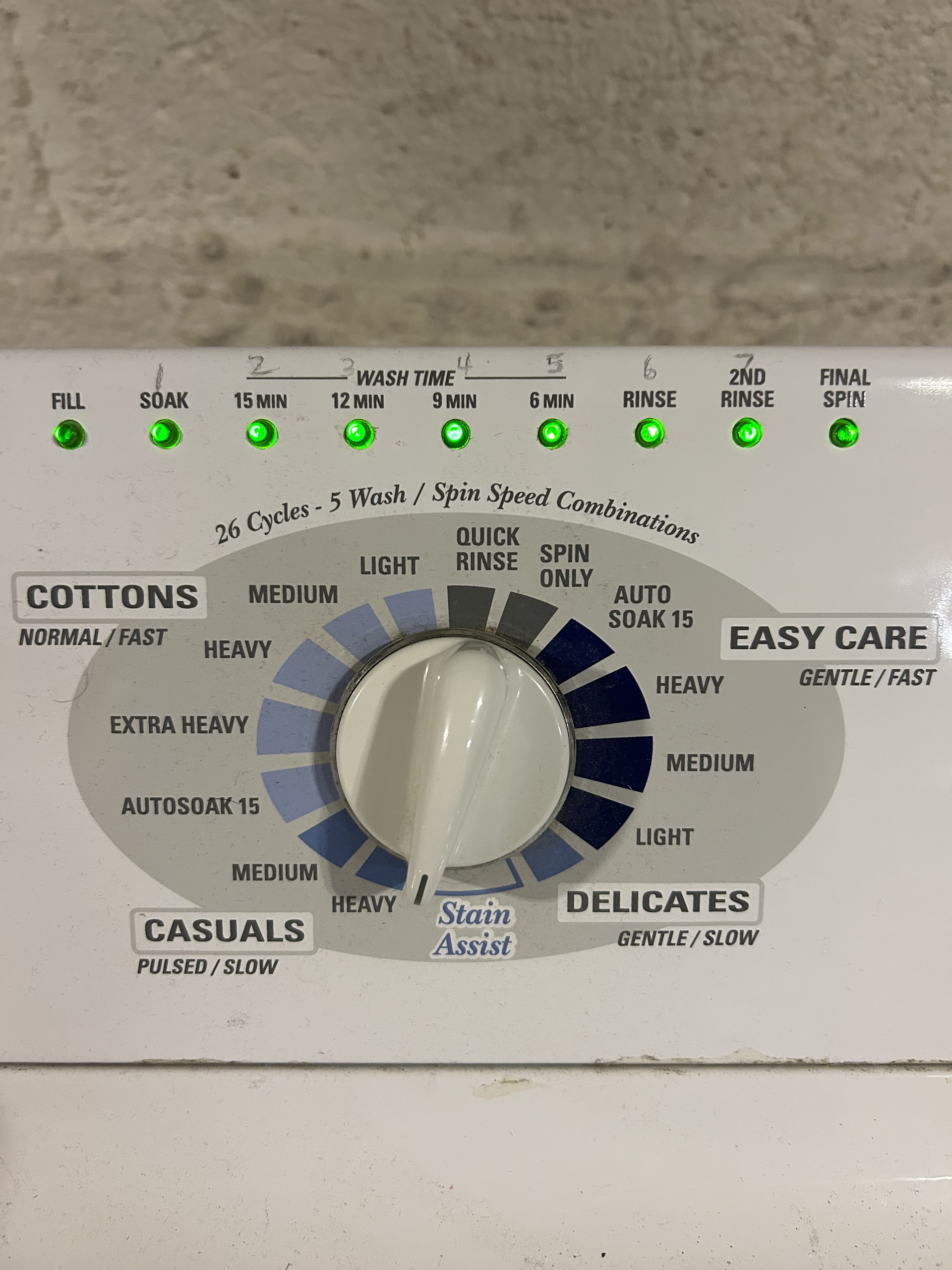
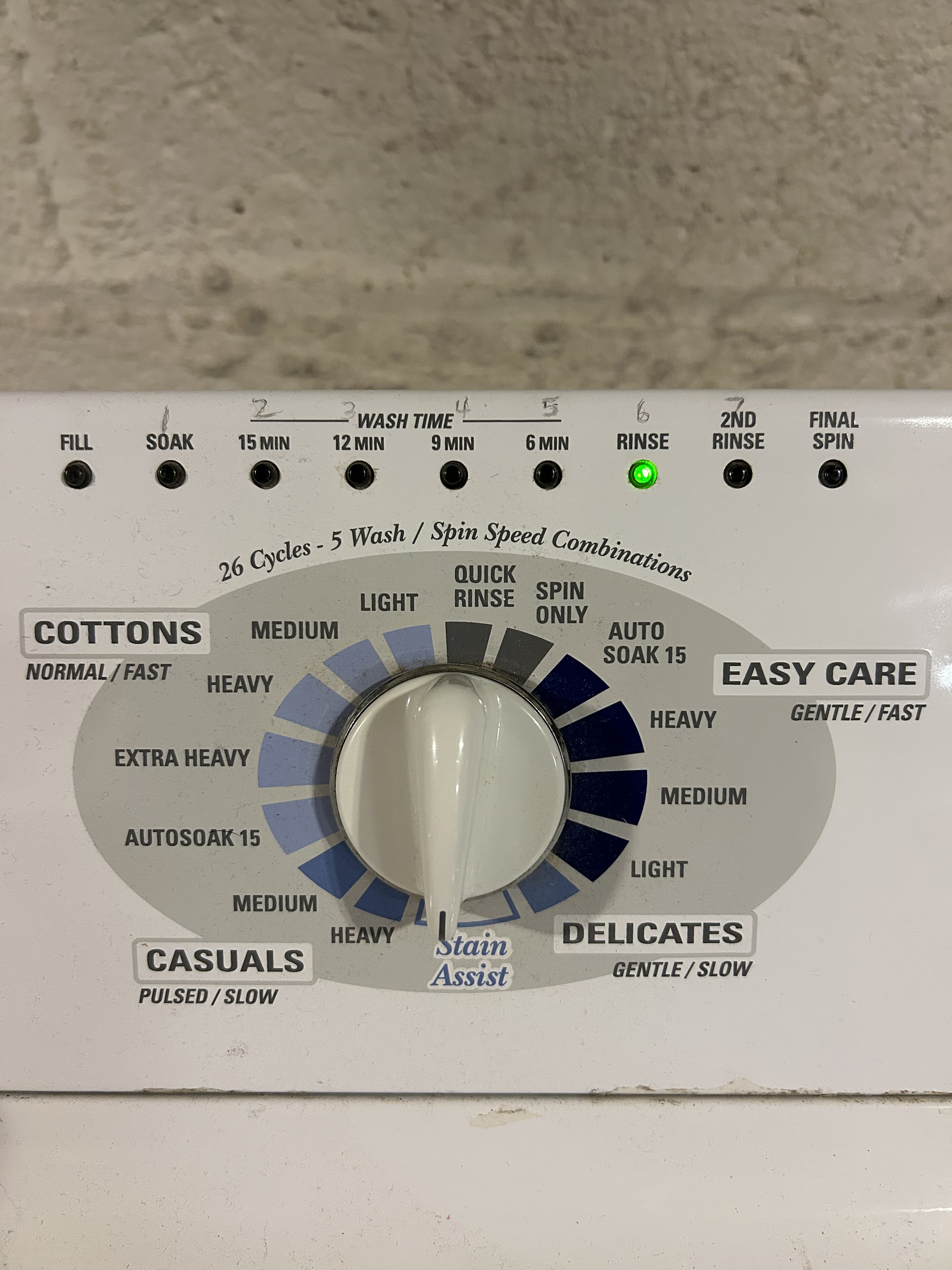
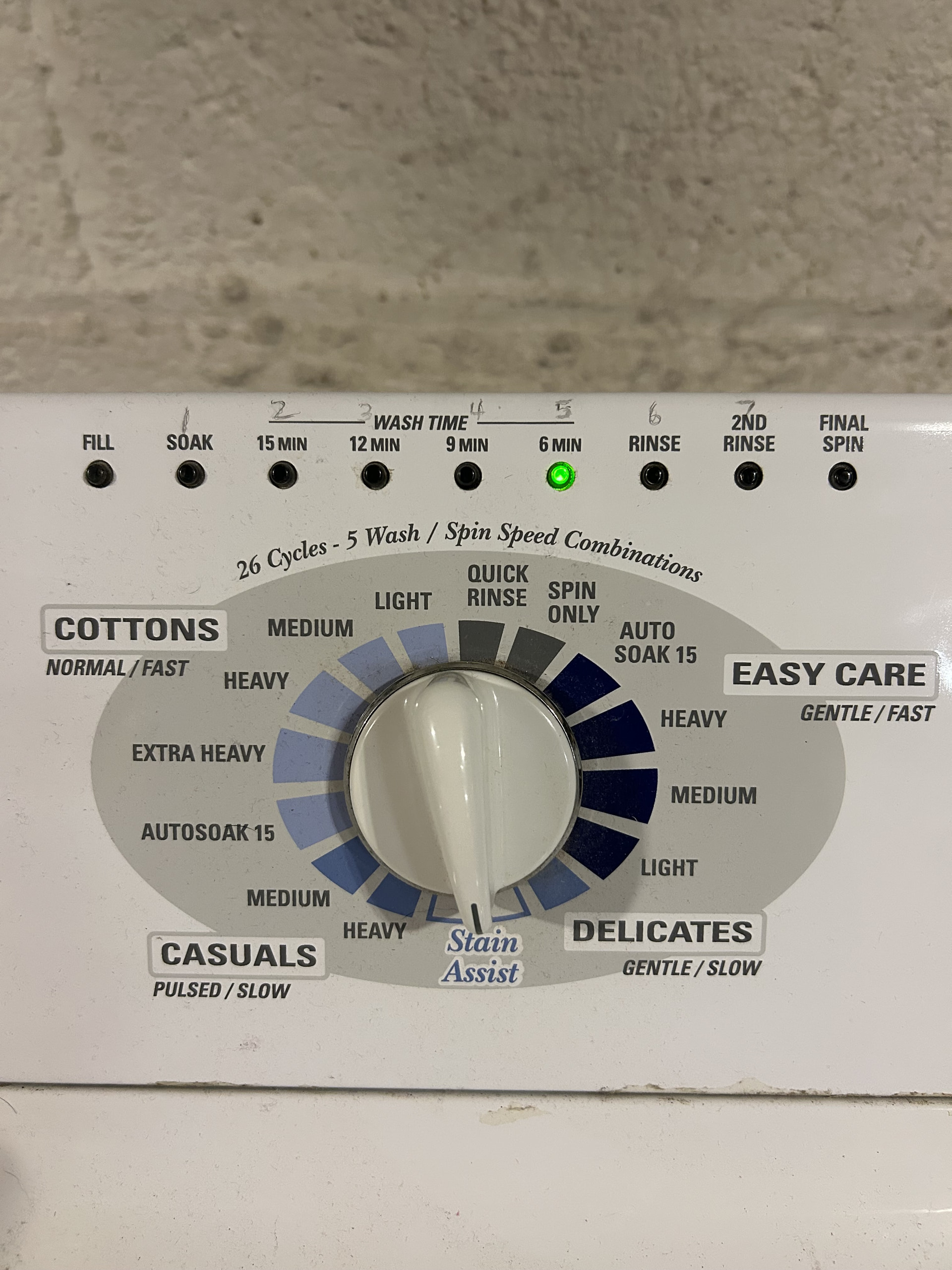
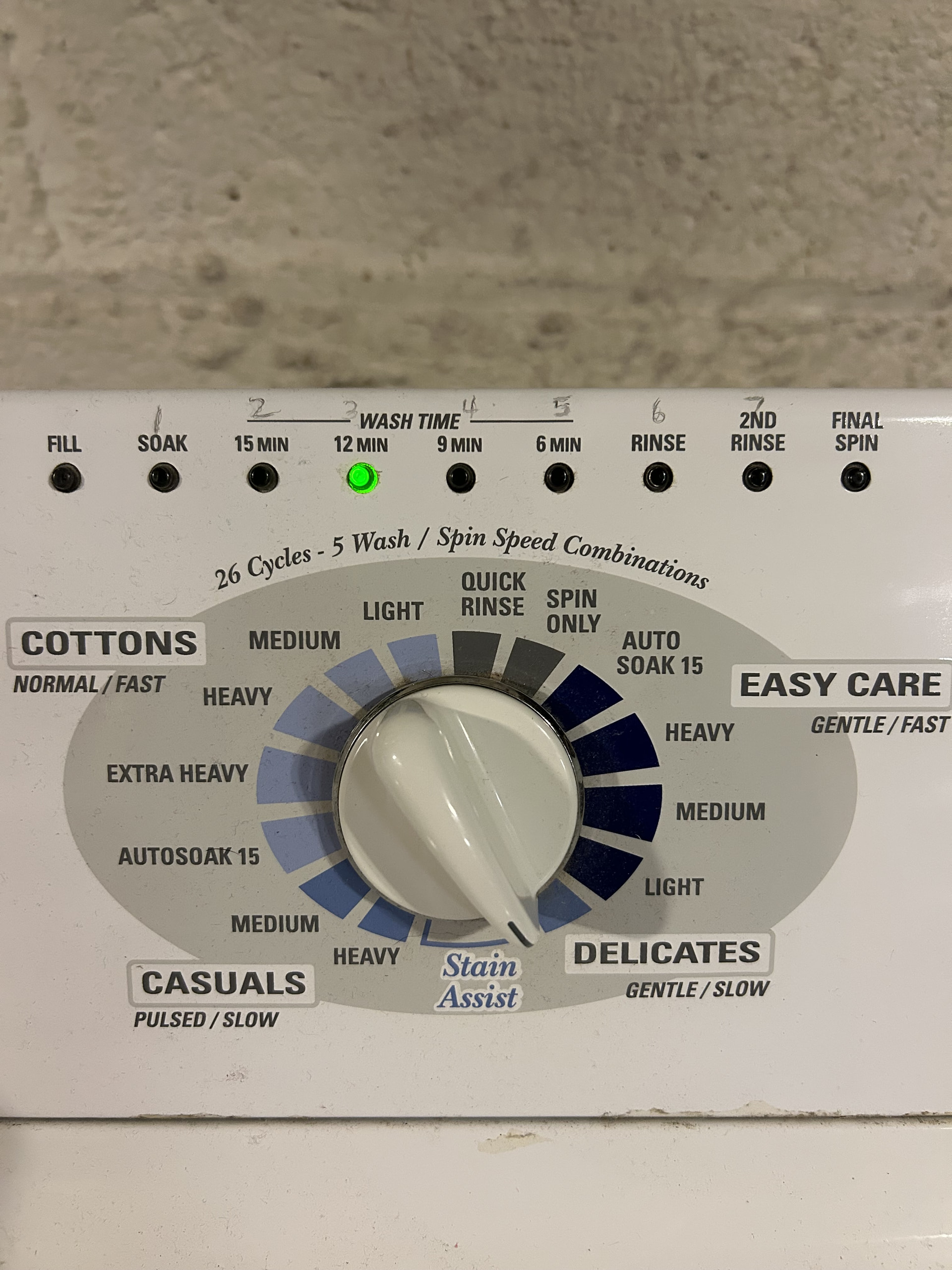
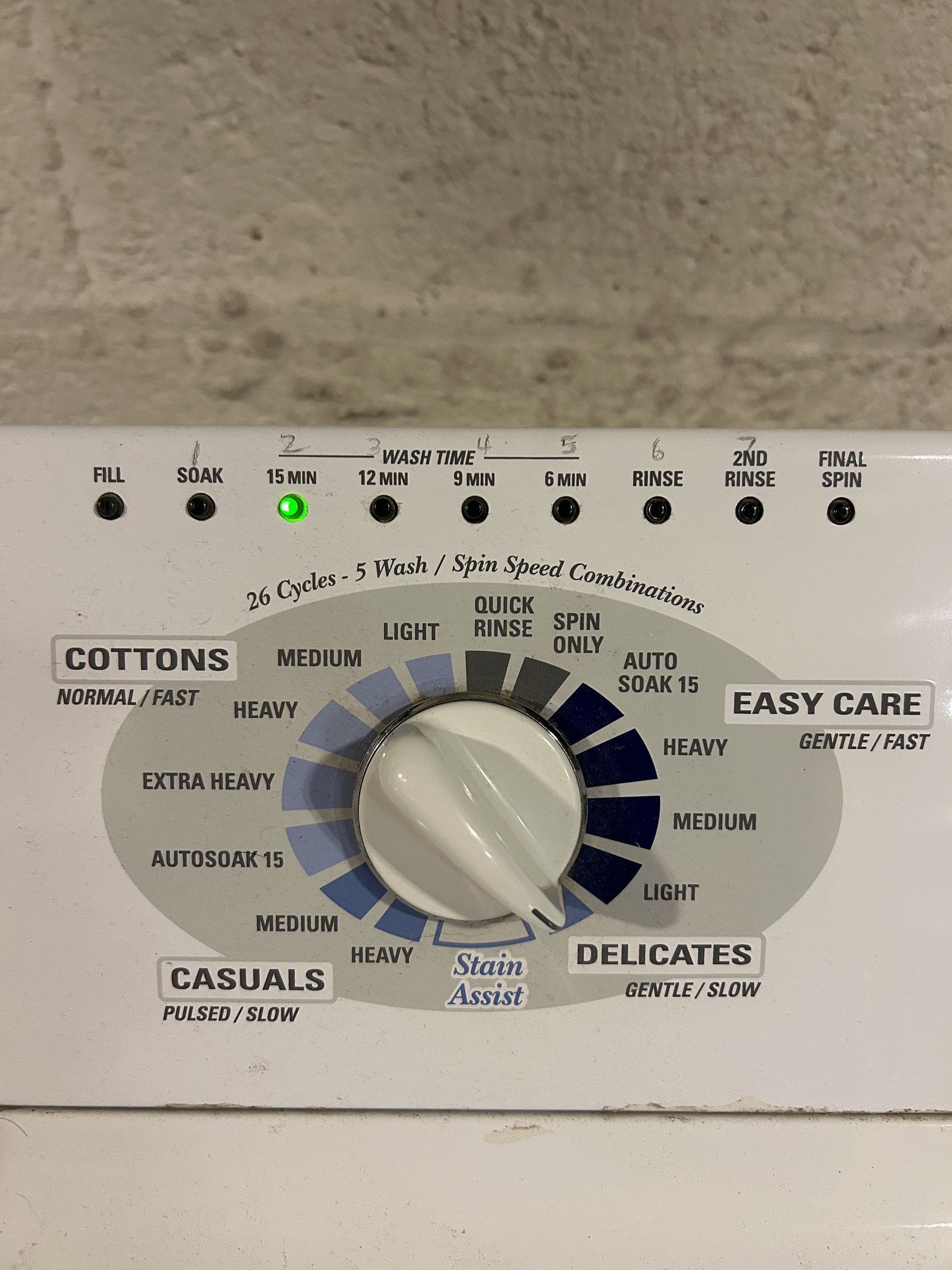
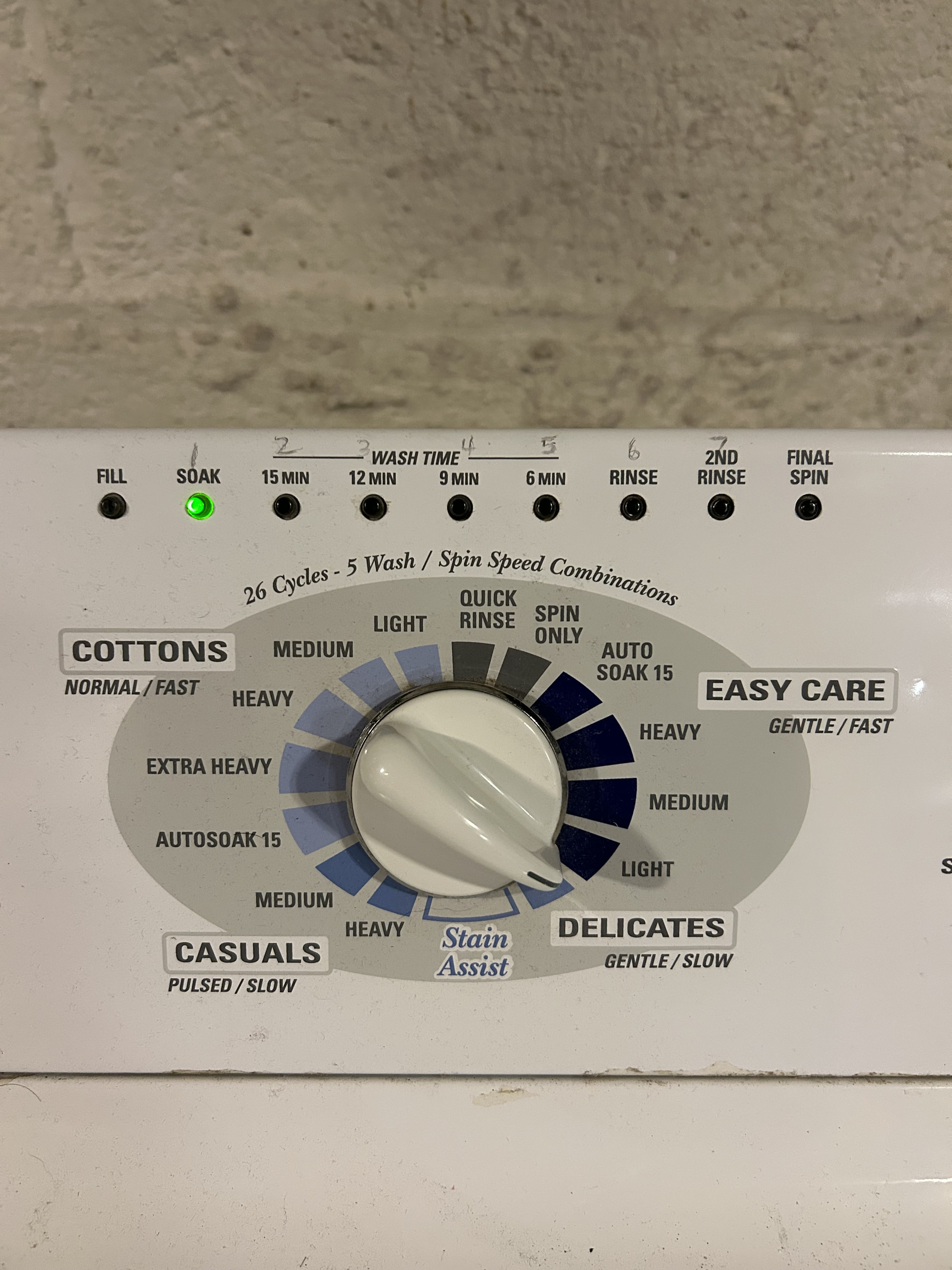
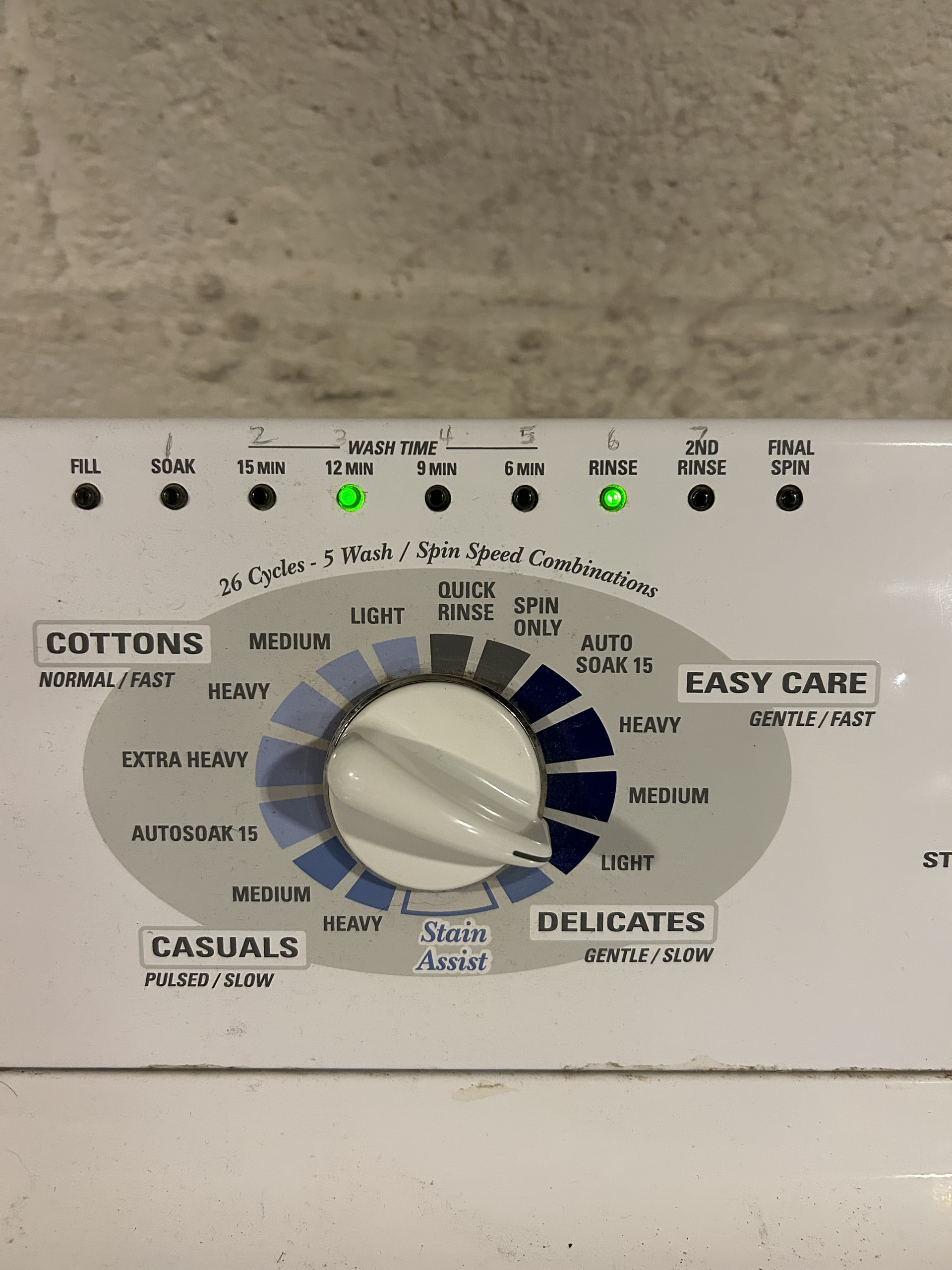
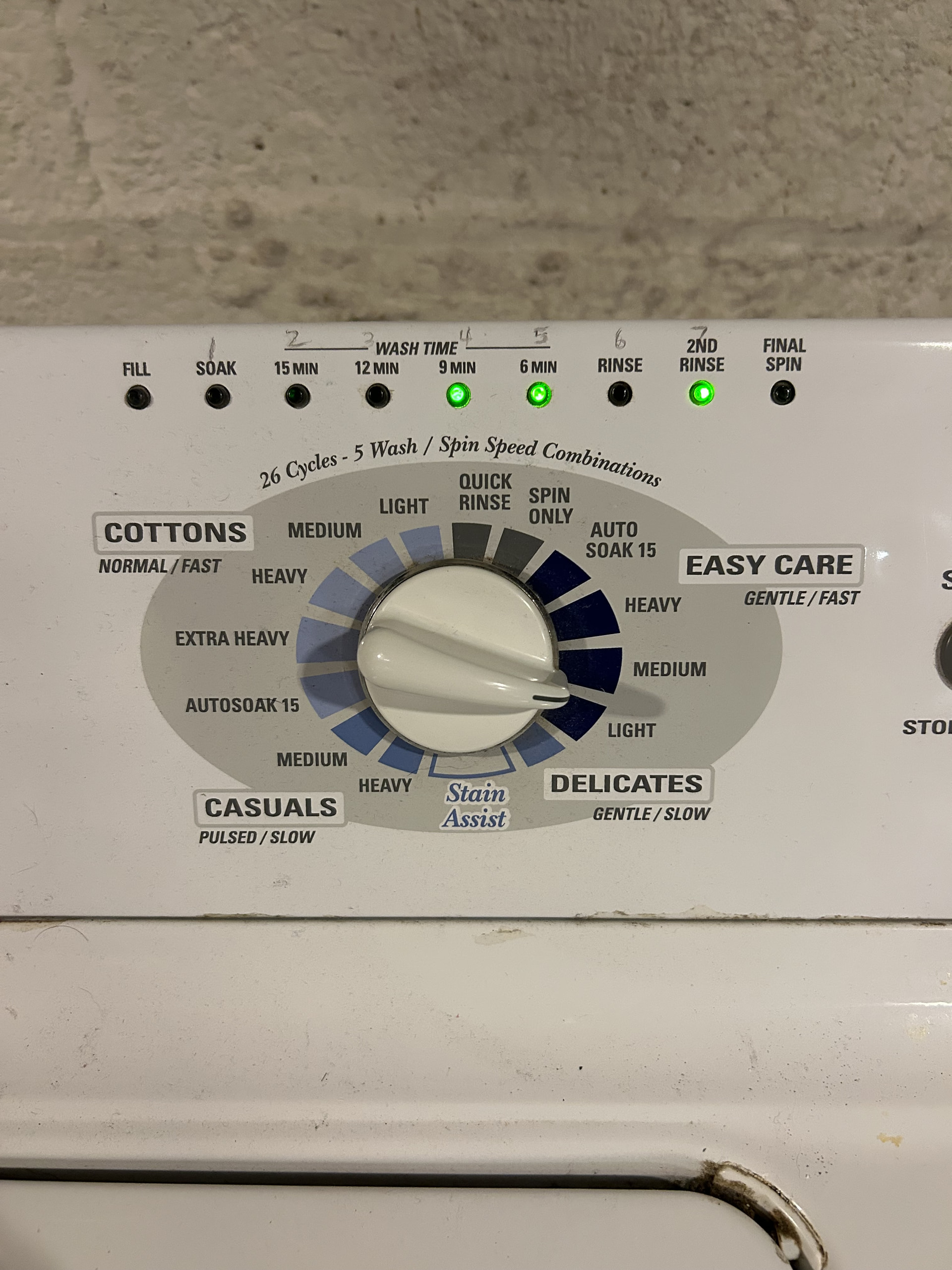
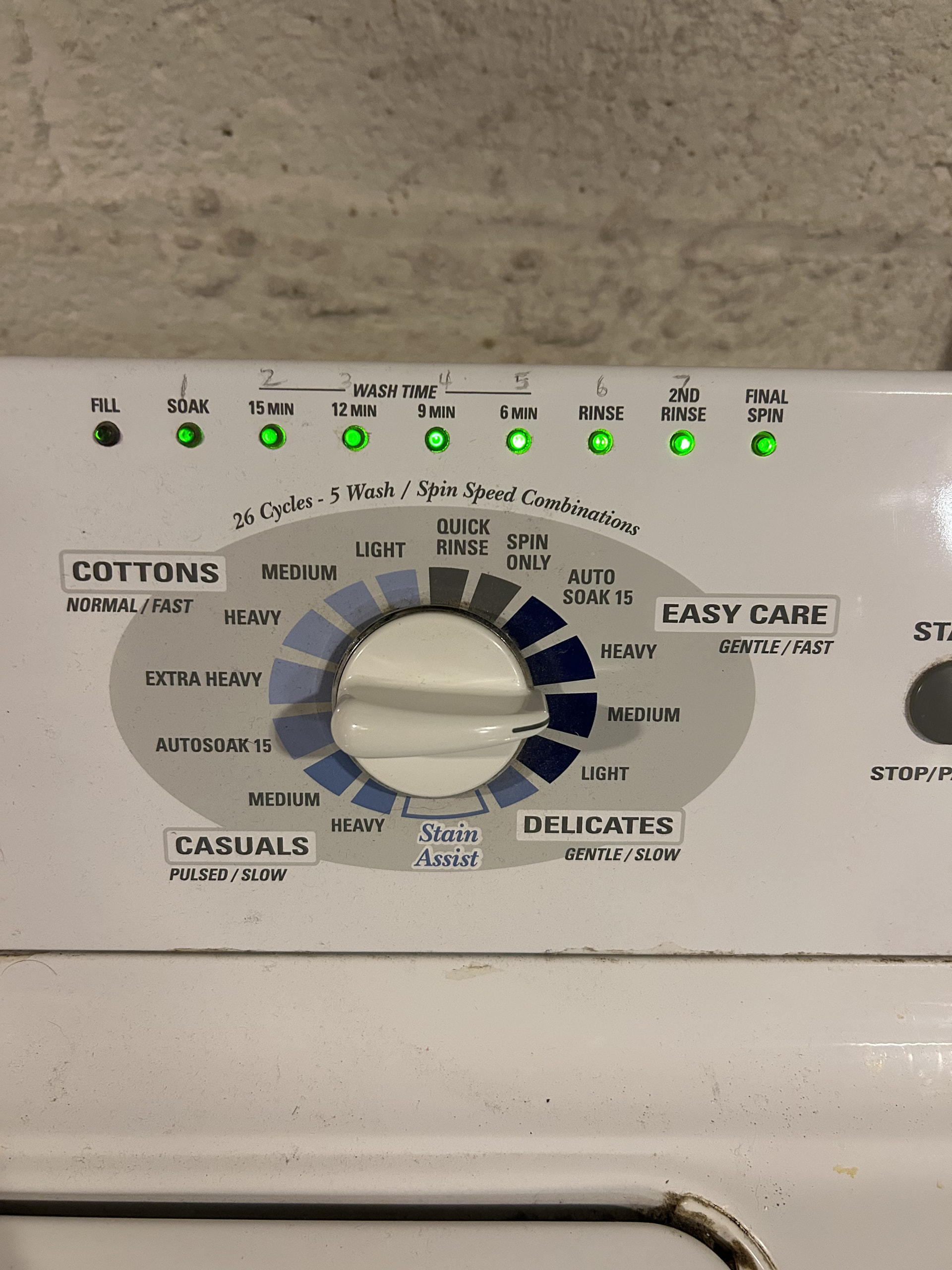
Lol, can’t upload a video! Attached are pics from each click in Field Service Mode. They uploaded in reverse time order; bottom right is first, top left is last.
No worries! The pictures work just fine. Thanks for numbering the lights as well. That makes it much easier to follow the diagnostic chart.
Field Service Mode results
Reading your pictures in reverse order, starting with the LED check:
Position 0 – LED check: All nine lights illuminate. Good.
Position 1 – Model identification: LEDs 4, 5 and 7 illuminate.
Position 2 – Stored error codes: LEDs 3 and 6 illuminate, indicating No Fill and Flood errors, according to your diagnostic sheet.
Position 3 – Hot water valve: Soak LED.
Position 4 – Cold water valve: 15-minute LED.
Position 5 – Slow agitation: 12-minute LED.
Position 6 – Fast agitation: 9-minute LED.
Position 7 – Drain pump: 6-minute LED.
Position 8 – Spin: Rinse LED.
The individual lights in positions 3 through 8 identify the selected component tests. They do not necessarily indicate that those components passed their tests.
The stored water-level-related errors could be from previous incidents. Neither directly explains the basket coasting.
Checking the brake
With the washer unplugged and the drive belt removed:
Gently rotate the inner basket by hand and check how much resistance you encounter.
Watch the transmission assembly underneath while turning the basket.
If the basket rotates independently of the transmission’s spin housing, suspect the corroded mounting hub or its connection.
If the basket and transmission spin housing rotate together freely without the brake holding, suspect the transmission brake assembly.
Given the amount of water you found, I would also inspect the transmission for evidence of water entering the brake assembly.
I’m particularly concerned about the corrosion on that mounting hub. The holes indicate actual structural deterioration, not just surface corrosion. Even if the brake turns out to be good, the hub needs replacing.
I wouldn’t run any more powered spin tests until the mounting hub has been replaced and the leak corrected.
Let me know what you find when turning the basket by hand with the belt removed. That should help us narrow this down without spending money unnecessarily.