Brand:samsung
Model Number:DV419aew/xxa
Main Symptom:quits spinning
What happens & when:after 20 mins spinning everything tur off. wont power up.
Error Code (if any):no
Parts or tests already tried:
Photos / video link:
Brand:samsung
Model Number:DV419aew/xxa
Main Symptom:quits spinning
What happens & when:after 20 mins spinning everything tur off. wont power up.
Error Code (if any):no
Parts or tests already tried:
Photos / video link:
Hi jr1234,
Have you checked these few things that can cause the dryer to run for a few minutes and then stop?
Based on the symptoms you described, the most common cause is a failing drive motor. As the motor overheats, its internal thermal protector will shut it off. Once it cools down, it may run again for a few minutes before stopping, which is a classic sign of a motor that’s wearing out.
I cleared out a hugh mat of lint out of the cover that goes between the lint door down to the blower wheel.There was also lint wrapping onto and into the wheel. I cleared the wheel and ducting completely out. all the way to the wall.Perfect air flow. no obstructions. On checking ‘Low voltage’ the 220 power cord the dryer is using is over twice as long as the original,consisting of two cords plugged together to get to the wall socket. Could the longer distance/cords cause a problem? Everything has worked fine before with the previous dryer. It could be three tilmes longer,I dont know. What should it read when i put the meter on it? Thanks for your help,I wish i could put this to bed,I figured pulling out that massive amount of lint would have fixed it. Probly just put a heavier strain on all the other components.
Yes, the longer power cord can affect performance if it’s undersized or causing a voltage drop. Also, all that lint buildup could have made the dryer work much harder than normal.
A meter reading of around 220 volts, or a little over, is perfectly fine. At this point, if the problem keeps happening, the drive motor could be the issue. As the motor begins to fail, it can overheat and shut down after running for a while.
The replacement power cords are the same heavt duty cords like the original.Not undersized. If the voltage turns out o.k. , is there a way to check the motor to be sure its failing? Or the motor actuator you mentioned earlier?
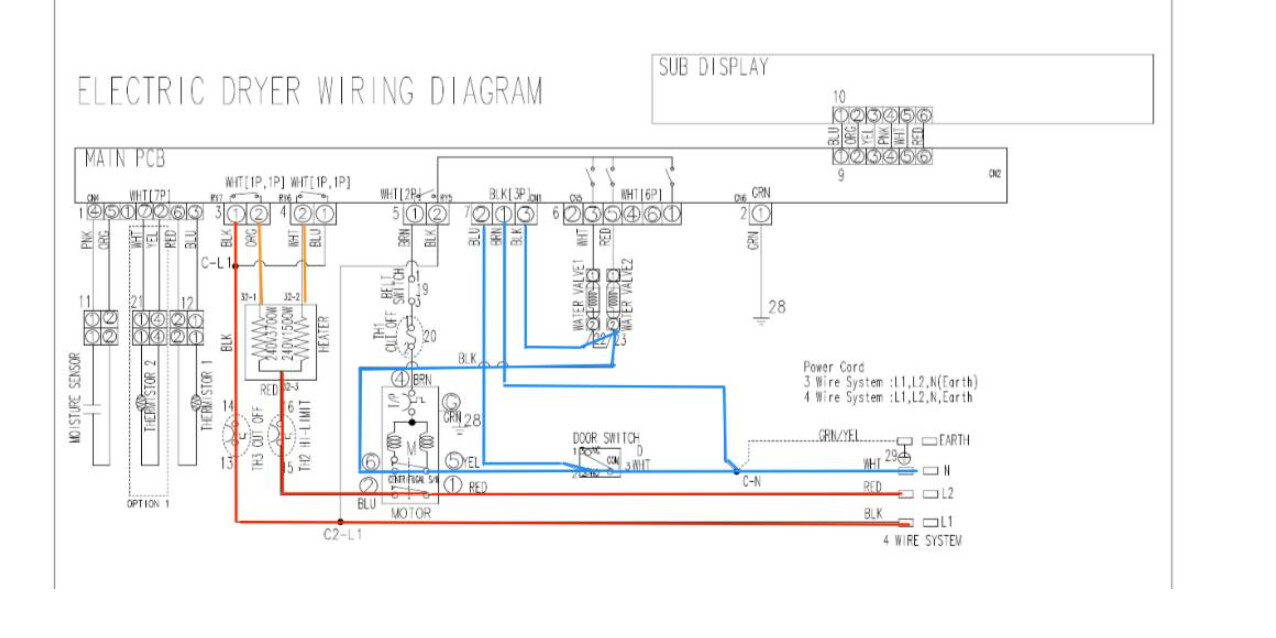
Main PCB to Motor Control Layout
The main control board supplies 120 VAC (L1) to the motor through the motor relay. Before power reaches the motor windings, it passes through the belt cut-off switch. If the drive belt breaks or slips off the drum, this safety switch opens, preventing the motor from running or even humming.
The neutral (N) side of the circuit passes through the door switch. Opening the dryer door breaks the circuit immediately, stopping the motor.
The drive motor uses a standard 6-pin terminal block. The wiring is as follows:
| Pin | Wire Color | Function |
|---|---|---|
| Pin 1 | Red | Routes to the high-limit thermostat and heating element circuit. |
| Pin 2 | Blue | Supplies the main start/run windings through the control board relay. |
| Pin 3 | Black/Orange | Connects to the internal centrifugal switch, which closes the heater circuit once the motor reaches operating speed. |
| Pin 4 | Brown | Connects to the thermal overload protector and belt switch safety circuit. |
| Pin 5 | Yellow | Sends a feedback signal to the main control board so it can detect that the motor is running. |
| Pin 6 | No Connection | Unused terminal on the motor block. |
Motor hums but won’t tumble
Dryer is completely dead or the motor won’t run
These checks will help determine whether the problem is in the safety circuit, wiring, or the drive motor itself before replacing any parts.