Brand: GE Cafe Model Number: cfe28up2mis1 Main Symptom: leak into fridge What happens & when: after water/coffee use
Error Code (if any): n/a
Parts or tests already tried:
Photos / video link:
I have taken off the panel and found no obvious source for the leak. Water seems to drip from the hoses until the small pan fills and overflows. My hunch is that it is from the Keurig and not cold water dispenser.
Any tips to diagnose? Is there a way to test with the door open?
Yes. Based on when the leak occurs, I would concentrate on the Keurig/hot-water system first, rather than the normal cold-water dispenser.
GE specifically notes that a restriction or problem in the Keurig brewer can cause water to be diverted inside the door, where it can eventually drip from the bottom or overflow an internal collection area.
Quick way to isolate it
Start with the easiest comparison test:
Dry the inside of the dispenser area, hoses, and small pan completely.
Put paper towels around/below the tubing so even a tiny leak is easy to spot.
Dispense cold water only several times.
Wait a few minutes and inspect.
If everything stays dry, test the hot-water/Keurig side separately.
That distinction is useful because this refrigerator actually has two different dispensing paths. Cold water comes from the center dispenser tube, while hot water uses a separate stainless-steel tube on the right side.
Before taking anything else apart
Remove the Keurig brewer and inspect/clean it carefully, especially the upper and lower piercing needles.
GE says clogged needles can build pressure and cause the system’s relief valve to divert hot water inside the refrigerator door. That’s an especially good match for your description of water appearing on the hoses, collecting in the little pan, and eventually overflowing.
Also make sure:
The K-Cup is pushed completely down and actually gets pierced by the lower needle.
The brewer is pushed completely into its mounting bracket.
The brewer vent isn’t plugged.
The upper needle isn’t clogged with coffee grounds.
You aren’t running hot water through the brewer without a K-Cup installed. GE specifically warns that doing that can send hot water out the back of the brewer and into the dispenser area.
Can you test it with the door open?
You can observe the exposed dispenser components while testing, but I wouldn’t defeat/interfere with the door switch and then run unattended—especially with the hot-water system exposed.
A safer diagnostic is to leave the dispenser cover off, position the door where you can see the tubing, and perform separate cold-water and Keurig/hot-water tests while watching closely. Keep your hands away from the exposed electrical connections. The Keurig water can also be near boiling temperature.
Here’s what you’re looking for:
Cold water test leaks: follow the cold-water tubing and connections.
Only Keurig/hot-water test leaks: watch the silicone tubing, hot-water nozzle/tube connections, brewer connection, and particularly for water that appears to be coming from a relief/overflow path rather than an obvious cracked hose.
One clue I’d pay particular attention to: if you see the hoses get wet but can’t actually see a hose connection spraying, the water may be originating higher up and simply running down the outside of the hoses into that pan.
The parts diagram for your exact CFE28UP2MIS1 shows a separate silicone tube assembly in the dispenser door, so there are connections in this area worth inspecting rather than assuming the visible hose itself has failed.
What I suspect first
Given “leaks after water/coffee use” + no obvious leak with the panel removed + water eventually overflowing the small pan, I’d do the cold-water-vs-Keurig isolation test before ordering anything.
If cold water doesn’t cause it but a brew cycle does, clean the Keurig upper/lower needles first. If it still leaks, run another brew while watching where the first drop appears. That should tell us whether we’re dealing with the brewer/relief system, hot-water tubing/nozzle, or one of its connections.
One important clue: GE actually lists “water drips from inner door” as a symptom associated with a clogged top brewer needle.
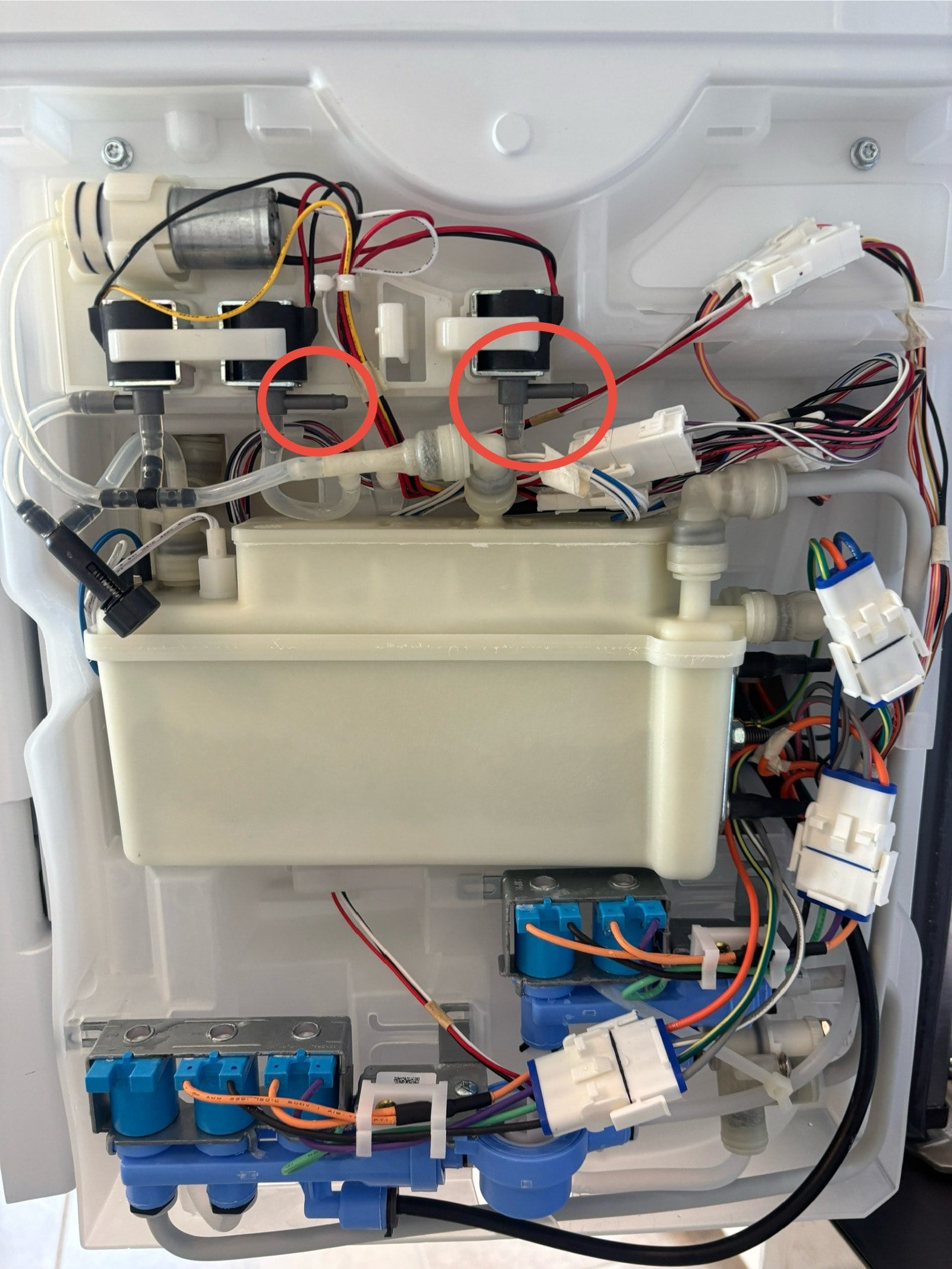
Thank you, after cleaning the brewer (bottom needle seemed a little clogged) I ran two brews with paper towels in the panel. The first brew had a water drop from the left circle and the right circle was very wet. What are these parts and the next step?
Awesome, this seems helpful but it will be a few days until I can check for obstructions per page 43 of 128, the leak seems to be from the Hot Water Tank Vent Valves and prescribes: check for obstructions in the hot water outlet tubing, the bracket and motor assembly or the pins in the brew module.
Yes — CFE28UP2MIS1 confirms this is the Café refrigerator with the Keurig K-Cup brewing system, so those circled components are part of a considerably more complicated water-routing system than a conventional refrigerator dispenser.
For this model, I would not assume those small gray horizontal nipples are broken or supposed to have hoses attached. The model uses the multi-valve assembly WR57X25390, and GE parts listings identify it as the applicable water-valve assembly for CFE28UP2MIS1.
More importantly, given your original symptom — water showing up on the hoses, collecting in that small pan, and overflowing after dispensing water/coffee — I’d concentrate on the Keurig pressure-relief/drain system.
What I would test
Dry that entire upper area and the collection pan. Then:
Dispense several glasses of cold water only. Watch those two circled ports and the tubing around them.
If it remains dry, run the Keurig/hot-water system while watching the same area.
Pay particular attention to whether water is actually coming out of one of the small horizontal gray ports rather than leaking around the gray valve body.
If water comes from one of those ports specifically during Keurig operation, I would not plug it. That’s strong evidence that you’re seeing water being intentionally relieved/drained because of a problem farther downstream.
Remove and thoroughly clean the Keurig brewer and both piercing-needle areas. A restriction in that path can cause pressure to build and water to be diverted internally.
The model also has a separate Keurig Single Serve Brew Module WR02X30247, so we don’t want to condemn the water valve simply because we’re finding water near it.
The most useful observation you can make now is this: watch the two circled horizontal nipples while somebody operates the dispenser. If you tell me left nipple, right nipple, both, or neither is actually discharging water—and whether it happens with cold water or Keurig—I can narrow this down considerably.
After running the cold water, hot water, and coffee brewing tests with the door open, I think I’ve solved the issue. Shocker: it’s (kind of) user error. When the leak was happening, we were brewing flavored coffee grounds (we use reusable pods). My best guess is the most recent bag happened to be heavily flavored (more sugars gumming up?) and more finely ground (more pressure build up?) than our usual. The most recent flavored bag was also brewing far less than 10 oz from the 10 oz setting. Today’s tests were done with a regular coffee/medium grind and no water was coming from the relief valves and the brews returned to the full 10 oz. The cleaning of the brew capsule bottom needle probably helped as well and I’ll do that more regularly.